What is a Supercomputer Complete Guide for Clear Understanding
Published: 9 Feb 2026
What makes a computer so powerful that it needs a special name? Many beginners feel confused when they hear the term and ask, what is a supercomputer in simple words. I have seen this confusion many times while explaining advanced computing systems, especially to new learners. That is why I explain the topic in a clear, practical way, using real examples from today’s technology.
In this article, we have covered what a supercomputer is, how it works, and why it plays a key role in modern science and technology. By the end, you will have a clear understanding of how these machines handle tasks far beyond ordinary computers.
Stay with me, and see what’s next in the world of supercomputers.
Definition of Supercomputer
Supercomputers are extremely powerful computers designed to handle calculations far beyond the capacity of ordinary computers. They are built to solve highly complex problems in very short timeframes.
These machines combine thousands of processors to work together efficiently, making them ideal for scientific and technical tasks. Supercomputers play a critical role in research, simulations, and areas requiring massive data processing.
- Extremely Fast Processing: They complete calculations at speeds millions of times faster than standard personal computers.
- Massive Parallel Computing: Supercomputers use thousands of processors simultaneously to tackle large-scale computations efficiently.
- Complex Problem Solving: They can handle tasks that involve huge datasets, advanced simulations, or intricate mathematical models.
- Specialized Design: Unlike normal computers, they are custom-built with advanced architectures tailored for high-performance computing.
- High Data Handling: Supercomputers manage enormous amounts of data at once without slowing down, which is impossible for regular systems.
- Cutting-Edge Research Support: They enable breakthroughs in science, engineering, weather prediction, and other critical fields by performing calculations that standard machines cannot.
History of Supercomputer
The history of supercomputers shows how computing power has grown dramatically over the decades. Early machines were huge, expensive, and limited in speed, but they laid the foundation for today’s advanced systems. Over time, supercomputers evolved to become faster, smaller, and more energy-efficient. They have been essential in science, defense, and industry, shaping technology as we know it.
- 1960s—The First Supercomputers: Machines like the CDC 6600, designed by Seymour Cray, marked the beginning of high-speed computing.
- 1970s – Enhanced Performance: Cray-1 introduced vector processing, making calculations faster and enabling more complex simulations.
- 1980s—Parallel Processing Emerges: Supercomputers began using multiple processors working together, increasing speed and efficiency.
- 1990s – Global Competition: Countries invested heavily in supercomputing for science, defense, and weather modeling, leading to record-breaking machines.
- 2000s – Teraflop Era: Supercomputers reached speeds of trillions of calculations per second, supporting large-scale scientific research.
- 2010s to Present – Exascale Computing: Modern supercomputers can perform quintillions of operations per second, powering AI, climate studies, and advanced simulations.
Types of Supercomputers
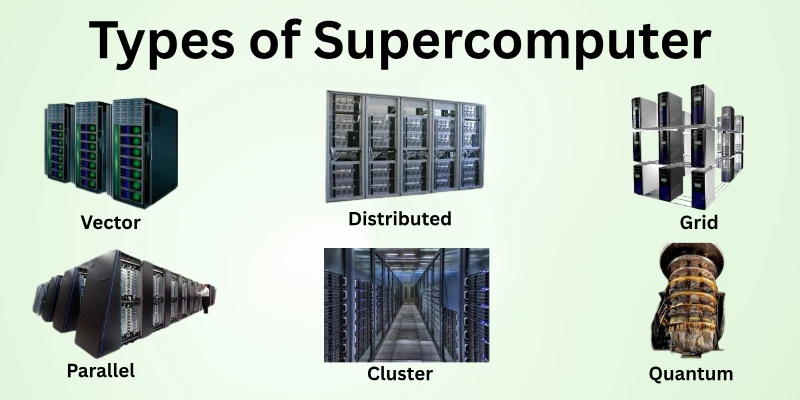
Supercomputers are not all the same; they come in different types depending on their design and purpose. Each type is built to handle specific kinds of tasks efficiently.
Some focus on speed, others on processing massive amounts of data or running complex simulations. Understanding the types helps us see how supercomputers are applied in science, industry, and research.
- Vector Supercomputers: Process large sets of numbers at once, ideal for scientific calculations.
- Parallel Supercomputers: Use many processors together to solve complex tasks quickly.
- Distributed Supercomputers: Connect multiple computers over a network for big projects.
- Cluster Supercomputers: Link standard computers for high performance and flexibility.
- Grid Supercomputers: Combine computing power from different locations for global tasks.
- Quantum Supercomputers: Use quantum mechanics to solve certain problems faster than classical machines.
How a supercomputer works
Supercomputers perform extremely large calculations at incredible speeds using thousands of processors working together. They combine advanced hardware, specialized memory, and optimized software to handle enormous data efficiently. These machines power scientific research, simulations, and other tasks that ordinary computers cannot manage.
- Parallel Processing Architecture: Uses multiple processors in structured networks to process tasks simultaneously without slowing down.
- High-Speed Data Transfer: Fast interconnections ensure processors can quickly exchange information for seamless operation.
- Advanced Algorithms: Specialized software directs task execution, balances workloads, and minimizes computation delays.
- Memory Optimization: Supercomputers use layered memory systems to store and access data quickly during complex operations.
- Energy and Thermal Management: Cooling technologies and power regulation prevent overheating and maintain consistent performance.
- Input/Output Handling: Efficient I/O systems manage massive data streams, ensuring results are processed and saved without bottlenecks.
Applications of Supercomputer
Supercomputers are used in areas where ordinary computers cannot handle massive calculations or large datasets. They help scientists, engineers, and researchers solve problems faster and more accurately. From exploring space to predicting the weather, these machines enable tasks that shape modern technology.
Their applications are diverse, impacting science, industry, and society in meaningful ways.
Climate and Weather Modeling: Supercomputers analyze enormous environmental data to predict storms, hurricanes, and long-term climate changes with high accuracy.
- Scientific Research: They simulate complex experiments, such as molecular interactions or astrophysical phenomena, which are impossible to recreate in reality.
- Medical and Genomic Studies: Supercomputers accelerate drug discovery, genetic mapping, and disease modeling to improve healthcare solutions.
- Artificial Intelligence and Machine Learning: High-performance systems train large AI models and process massive datasets more efficiently than conventional machines.
- Engineering and Manufacturing: Supercomputers test designs, simulate structural stress, and optimize production processes without physical prototypes.
- Defense and Security: They assist in cryptography, surveillance data analysis, and simulations of defense technologies for strategic planning.
World’s Most Famous Supercomputers
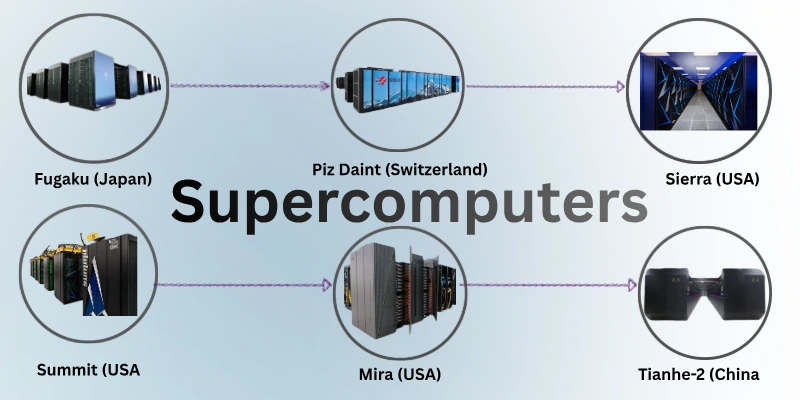
Some supercomputers have gained worldwide fame for their incredible speed and ability to handle tasks that ordinary computers cannot. They have transformed research, engineering, and technology, enabling breakthroughs in science and industry. Each system represents a milestone in computing and continues to inspire innovation.
- Fugaku (Japan): One of the fastest supercomputers, used for climate research, disaster simulations, and drug discovery. Its advanced design allows versatile high-speed calculations.
- Summit (USA): Built for AI and scientific simulations, Summit handles massive datasets efficiently for genetics, material science, and physics research.
- Sierra (USA): Focused on nuclear research and national security, Sierra performs complex calculations to safely test and validate defense technologies.
- Sunway TaihuLight (China): Supports weather forecasting, manufacturing, and scientific modeling with trillions of calculations per second.
- Tianhe-2 (China): Delivers immense processing power for space exploration, climate modeling, and big data research with thousands of processors in parallel.
- Piz Daint (Switzerland): Europe’s fastest hybrid supercomputer, ideal for climate studies, astrophysics, and engineering simulations.
- Mira (USA): Accelerates research in energy, nuclear simulations, and materials science, enabling detailed scientific models to be efficient.
Advantages of Supercomputers
Exploring complex problems becomes possible with machines that handle massive calculations. These systems help researchers and engineers make faster, more accurate decisions. They open new doors in science, technology, and innovation.
Check out the main benefits of using supercomputers:
- High Processing Power: Perform massive calculations quickly, saving time on complex tasks.
- Efficient Data Handling: Manage and analyze huge datasets without slowing down.
- Accurate Simulations: Create precise models for climate, physics, and engineering experiments.
- Enhanced AI Capabilities: Train and test large artificial intelligence and machine learning models effectively.
- Faster Research and Innovation: Accelerate discoveries in medicine, technology, and scientific research.
Disadvantages of Supercomputer
While these machines achieve extraordinary performance, they come with significant challenges. Their cost, size, and energy demands make them difficult to maintain for many organizations. Understanding the drawbacks helps appreciate the complexity of using such advanced technology.
Here are the main limitations of supercomputers:
- High Cost: Building and maintaining these systems requires millions of dollars.
- Large Physical Space: They need specially designed rooms with proper infrastructure.
- High Energy Consumption: Operating these machines consumes enormous amounts of electricity.
- Complex Maintenance: Specialized staff is required to manage hardware and software issues.
- Limited Accessibility: Only research institutions or large organizations can afford to use them.
- Software Limitations: Custom programs are often required, which can be costly and hard to develop.
- Environmental Impact: The energy and cooling demands can contribute to a significant carbon footprint.
Future of Supercomputing
The future of supercomputing promises faster, smarter, and more energy-efficient machines. New technologies will allow researchers to tackle problems that are currently impossible. These advancements will impact medicine, space exploration, climate studies, and artificial intelligence. Supercomputers will continue to shape science, industry, and everyday life in remarkable ways.
- Exascale Computing: Perform quintillions of calculations per second for faster problem-solving.
- Quantum Integration: Combine quantum and classical systems for expanded computing power.
- Energy Efficiency: Reduce power use while maintaining high performance.
- Advanced AI: Support and train more complex artificial intelligence models.
- Global Collaboration: Connect supercomputers worldwide to share data and simulations.
- Smaller and Accessible: High-performance systems become more compact and affordable.
Final Thought
In this guide, we have covered what is a supercomputer, its future, and its history. While supercomputers offer incredible speed and power, they also come with high costs, energy use, and maintenance challenges.
I recommend balancing these advantages with the limitations carefully, planning proper resources and skilled staff to manage them effectively. By understanding both the benefits and risks, we can use these machines safely and wisely.
Thank you for reading this guide, and I hope it was helpful and informative. Don’t skip the next part of the FAQs. I hope you will find something more interesting, so don’t miss it. If you miss it, you may lose something new.
FAQS: What is a Supercomputer
Now that you understand the basics, let’s explore some frequently asked questions to explore more details and clear any doubts.
Supercomputers are used in climate modeling, space research, medicine, and artificial intelligence. They can simulate natural disasters, design new materials, and process large datasets efficiently. Many governments and research institutions rely on them for advanced scientific studies.
Supercomputers are mainly used by governments, research institutions, universities, and large tech companies. Scientists, engineers, and data analysts rely on them to solve complex problems. They are not commonly available for personal use due to high costs and technical requirements.
Here is a quick comparison between a regular computer and a supercomputer.
Regular Computer: A device for everyday tasks like browsing, typing, or watching videos. It cannot handle very large calculations or complex simulations.Supercomputer: A powerful machine that processes massive data at high speed. It uses thousands of processors to solve scientific and research problems beyond a regular computer.
Supercomputers consume large amounts of electricity, but modern designs aim to improve energy efficiency. Advanced cooling systems and low-power processors help reduce waste. Despite improvements, energy use remains one of their biggest challenges.
Here are the main ways supercomputers help in scientific research
- Simulate experiments that are impossible in real life.
- Analyze massive datasets quickly and accurately.
- Model complex systems in physics, chemistry, and biology.
- Support space exploration and astrophysics research.
- Enable discoveries that are too risky or time-consuming otherwise.
Here are the main reasons why supercomputers are so expensive
- Advanced hardware components cost millions.
- High energy consumption adds to running expenses.
- Specialized cooling systems require extra investment.
- Skilled staff are needed for maintenance and operation.
- Only large organizations or governments can afford them.
Currently, Fugaku in Japan is considered one of the fastest supercomputers. It handles tasks like drug discovery, disaster simulations, and climate modeling. The power of these machines is measured in FLOPS (floating-point operations per second).
Yes, they are ideal for AI and machine learning because they can process massive datasets quickly. Supercomputers can train deep learning models faster than regular computers. This enables research in autonomous systems, medical AI, and data analysis.


- Be Respectful
- Stay Relevant
- Stay Positive
- True Feedback
- Encourage Discussion
- Avoid Spamming
- No Fake News
- Don't Copy-Paste
- No Personal Attacks
- Be Respectful
- Stay Relevant
- Stay Positive
- True Feedback
- Encourage Discussion
- Avoid Spamming
- No Fake News
- Don't Copy-Paste
- No Personal Attacks
