What is a Hybrid Computer Learn Everything Beginners Should
Published: 22 Feb 2026
Why do some machines process real-time signals and complex calculations together without slowing down? Many learners feel confused and ask, What is a hybrid computer, and how does it differ from other systems?
I see students mix this concept with digital computers very often, and that confusion creates bigger learning gaps. In this guide, we have covered its definition, working process, real-world uses, and key differences in a simple way.
I will explain everything clearly so you finally understand it without any confusion. You will also see practical examples that make the concept easy to remember. By the end, you will feel confident explaining it to others without hesitation.
Now, let’s clearly understand what a hybrid computer actually means, so stay with me.
What is a Hybrid Computer? Simple Words
A hybrid computer combines the features of both analog and digital computers to perform tasks efficiently. It handles complex calculations quickly while also processing continuous data accurately.
These computers are often used in specialized environments where precision and speed are both essential. They bridge the gap between traditional computing methods for better results.
- Used in weather forecasting systems
- Powers medical imaging machines
- Controls industrial automation processes
- Monitors scientific experiments closely
- Enhances simulation and modeling tasks
History of the Hybrid Computer
Hybrid computers evolved over decades of innovation. They combined the speed of digital systems with the precision of analog machines. Engineers and researchers first developed them to solve scientific and military challenges.
Over time, industries, laboratories, and healthcare facilities adopted them, and continuous improvements in accuracy, adaptability, and processing power transformed them into versatile tools for specialized computing tasks.
- 1950s development: The first hybrid machines tackled complex military calculations, helping engineers and researchers solve advanced defense and engineering problems efficiently.
- 1960s expansion: Universities and laboratories adopted hybrid systems to conduct precise scientific experiments that required both fast computation and continuous data analysis.
- 1970s advancement: Industries began using hybrids for real-time process control, enhancing production efficiency and minimizing errors in manufacturing operations.
- 1980s innovation: Improved precision supported the growth of medical imaging and diagnostic technology, making healthcare processes faster and more reliable.
- 1990s modernization: Hybrid computers integrated enhanced software and hardware interfaces, enabling detailed simulations, modeling, and research in engineering and science.
- 2000s era: These systems powered large-scale industrial simulations and specialized applications, bridging analog intuition with advanced digital accuracy for complex tasks.
Evolution of the Hybrid Computer
Hybrid computers evolved as engineers combined the strengths of analog and digital systems to meet growing technological demands. Over the years, advancements in hardware and software enhanced their speed, accuracy, and versatility.
Researchers and industries continuously refined these machines to handle increasingly complex calculations and real-time data processing. Today, hybrid computers play a crucial role in specialized fields that require both precision and efficiency.
- Early experiments: Engineers tested hybrid concepts to merge digital speed with analog precision for solving practical problems.
- Hardware upgrades: Developers introduced faster processors and more reliable components to handle larger datasets efficiently.
- Software integration: Programmers created advanced software interfaces to manage real-time operations and complex simulations.
- Industrial adoption: Factories and laboratories deployed hybrids to monitor production lines and control automated systems effectively.
- Scientific breakthroughs: Researchers used hybrid systems to simulate environmental models, study physical phenomena, and predict outcomes.
- Modern refinement: Companies continue improving hybrid designs to support specialized applications in medicine, engineering, and advanced research.
How Hybrid Computers Work
Hybrid computers operate by combining the continuous data processing of analog systems with the logical computation of digital systems. They receive input signals, process them using specialized circuits, and deliver fast, accurate results.
Engineers design these machines to handle multiple types of data simultaneously, making them suitable for complex and real-time operations. By coordinating both analog and digital processes, hybrid computers achieve efficiency and precision in tasks where a single system might fall short.
- Signal reception: Machines capture analog and digital inputs simultaneously to ensure real-time processing accuracy.
- Data conversion: Continuous analog signals transform into precise digital values for calculation and analysis.
- Processing units: Specialized hardware performs computations and interprets data at high speed.
- Memory integration: Systems store both temporary and long-term data for seamless task execution.
- Output delivery: Computers produce results in readable formats for industrial, medical, and scientific applications.
- Error detection: Continuous monitoring identifies inconsistencies and automatically adjusts operations.
- Task coordination: Multiple processes run simultaneously without slowing down performance or accuracy.
- System optimization: Engineers fine-tune hardware and software for maximum efficiency under complex workloads.
Core Features of a Hybrid Computer
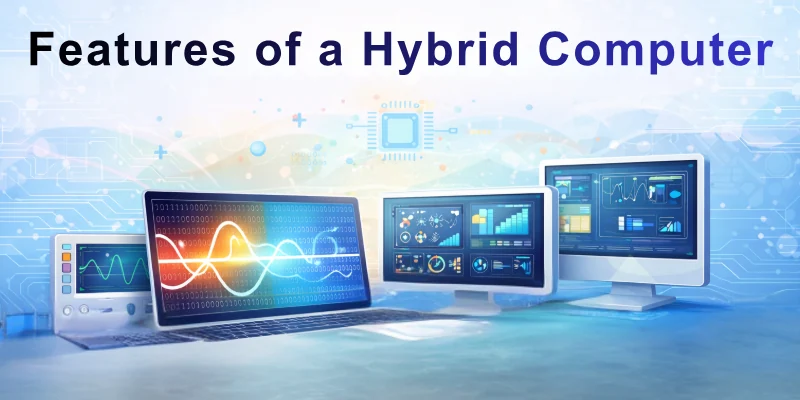
These machines deliver versatile performance by combining the strengths of analog and digital systems. They handle both continuous and discrete data, making complex tasks more manageable. Engineers design their features to improve speed, accuracy, and adaptability. The core functionalities allow efficient operation across scientific, industrial, and medical applications.
- Dual processing modes: Executes analog and digital computations simultaneously, allowing the computer to handle multiple types of data in real time.
- High-speed performance: Performs complex calculations rapidly without compromising accuracy, ensuring fast results for critical tasks
- Real-time processing: Processes incoming data instantly, providing immediate analysis and supporting quick decision-making in dynamic environments.
- Accuracy management: Maintains precise results under varying operational conditions, reducing errors and improving overall reliability.
- Versatile connectivity: Interfaces smoothly with a wide range of input and output devices, enabling diverse applications across multiple industries.
- Scalable architecture: Adjusts hardware and software resources efficiently, supporting increased computational demands as tasks grow more complex.
- Error control systems: Monitors operations continuously to detect and correct inconsistencies automatically, ensuring consistent and reliable output.
- Specialized support: Provides tailored capabilities for industrial, medical, and research applications, enhancing efficiency in specialized environments.
Types of Hybrid Computers
Computing systems have evolved to meet different operational needs, resulting in distinct types of hybrid machines. Each type focuses on balancing speed, accuracy, and versatility for specific tasks.
Designers tailor these systems to handle specialized environments, from research laboratories to industrial automation. Understanding the variations helps select the right system for particular applications.
- Analog-digital combination: Integrates analog signal handling with digital computation for tasks that require both continuous and discrete data.
- Real-time hybrids: Designed to process incoming data instantly, supporting critical operations that demand immediate results.
- Industrial control hybrids: Optimized to monitor production lines, control machinery, and manage automated systems efficiently.
- Scientific simulation hybrids: Built to perform detailed simulations and complex modeling for research and experimentation.
- Medical application hybrids: Support diagnostic imaging, patient monitoring, and precise measurement in healthcare environments.
- Embedded system hybrids: Small-scale, purpose-built machines that combine analog and digital processing for specialized devices.
- Networked hybrid systems: Connect multiple hybrid machines to share data and computations for collaborative or distributed tasks.
- Custom-configured hybrids: Tailored systems engineered for unique industrial, scientific, or educational requirements, offering maximum flexibility.
Practical Examples of Hybrid Computers
Modern industries and research institutions rely on hybrid systems to perform tasks that require both speed and precision. These machines excel in situations where continuous and discrete data must be analyzed simultaneously.
Engineers and scientists implement them to enhance efficiency, accuracy, and reliability across various fields. Examining practical examples helps understand how hybrid systems apply in real-world scenarios.
- Weather forecasting systems: Analyze real-time atmospheric data and run predictive models to provide accurate weather updates.
- Medical imaging machines: Capture precise scans, process data instantly, and support diagnostics for patient care.
- Industrial automation controllers: Manage production lines, regulate machinery, and maintain seamless workflow in factories.
- Scientific research simulators: Model complex physical, chemical, or environmental phenomena for experimental analysis.
- Traffic management systems: Monitor vehicle flows, process sensor data, and optimize urban traffic in real time.
- Flight simulation platforms: Combine continuous instrument readings and digital calculations for pilot training and aviation research.
- Power plant monitoring units: Track energy generation, detect anomalies, and maintain stable operations efficiently.
- Educational lab systems: Provide interactive experiments and simulations that integrate digital computation with real-world analog data.
Applications of Hybrid Computers
Across industries and research fields, hybrid systems solve problems that demand both speed and precision. By processing continuous and discrete data together, they enable real-time decision-making in complex environments.
Specialists rely on these machines to boost efficiency, maintain accuracy, and improve productivity. Exploring practical applications reveals the critical roles these systems play in modern technology.
- Aerospace navigation systems: Process flight data continuously while calculating optimal routes and real-time adjustments for safety.
- Nuclear research laboratories: Monitor radiation levels, control experiments, and analyze results with high accuracy and speed.
- Automobile testing units: Simulate vehicle performance, process sensor readings, and evaluate safety systems effectively.
- Financial analysis platforms: Combine real-time market data with algorithmic calculations to guide investment strategies.
- Telecommunication monitoring systems: Track network traffic, detect anomalies, and optimize data routing for reliability.
- Environmental modeling tools: Analyze climate data, predict weather patterns, and simulate ecological changes efficiently.
- Healthcare monitoring devices: Track patient vitals continuously while providing precise alerts and diagnostic calculations.
- Energy management systems: Supervise power grids, predict demand, and adjust distribution automatically to maintain stability.
Advantages of Hybrid Computers
Offering a unique combination of speed and precision, these systems excel in complex operations. Handling multiple types of data simultaneously improves efficiency in both industrial and scientific tasks.
Rapid and accurate results allow engineers to rely on them under varying conditions. Observing these benefits highlights why hybrid computers remain indispensable in modern technology.
- Reduces computation time efficiently
- Ensures high accuracy consistently
- Handles diverse tasks effectively
- Supports real-time decision-making
- Detects and corrects errors
Disadvantages of a Hybrid Computer
Maintaining hybrid systems can be complex and costly due to their combined analog and digital components. Their operation requires specialized knowledge, which limits accessibility for some users. Integration challenges may arise when adapting these machines to specific tasks. Despite their versatility, certain environments may find them less practical than simpler computing solutions.
- High setup and maintenance costs
- Requires specialized technical expertise
- Integration with systems is challenging
- Limited availability in small industries
- Complex troubleshooting consumes time
Hybrid Computer vs Analog Computer
At first glance, hybrid and digital computers may seem similar, but their operating principles differ significantly. One blends two technologies to boost performance, while the other focuses purely on precise digital processing. Understanding this difference can help you see which system truly fits modern computing needs.
Here’s what makes them truly different and why it matters for today’s technology.
| Hybrid Computer | Analog Computer |
| Can perform tasks of both digital and analog computers. | Processes continuous data that is neither discrete nor distinct. |
| Combines digital accuracy with analog speed. | Used in scientific and engineering applications to measure analog values. |
| Handles both continuous and discrete data simultaneously. | Solves complex equations instantly. |
| Improves efficiency by completing multiple operations at once. | Does not require storing memory for calculations. |
| Can process real-time data quickly. | Provides smooth and continuous measurements. |
| Offers flexibility for industrial and research applications. | Limited to specific applications and tasks. |
Future Trends
Computing technology continues to evolve with strong momentum and clear direction. Modern systems now focus on delivering speed, intelligence, security, and sustainability at the same time. Industries expect computing solutions that not only perform faster but also adapt to changing demands. These powerful trends will shape the structure and capabilities of future computer systems worldwide.
- Artificial Intelligence Growth Trend: Intelligent algorithms will automate complex tasks, enhance predictive analysis, and strengthen decision-making across industries.
- Quantum Computing Expansion Trend: Advanced quantum processors will tackle extremely complex problems that traditional architectures cannot efficiently solve.
- Edge Computing Acceleration Trend: Organizations will process data closer to devices to minimize delays and improve operational responsiveness.
- Sustainable Technology Development Trend: Engineers will design low-power systems that reduce environmental impact while maintaining strong performance levels.
- Cybersecurity Reinforcement Trend: Security models will integrate advanced encryption and threat detection mechanisms to defend sensitive information.
- Cloud Computing Evolution Trend: Scalable cloud infrastructures will support flexible storage solutions and high-speed remote collaboration.
- Automation Advancement Trend: Smart systems will streamline workflows, reduce manual effort, and increase productivity in industrial environments.
- Human-Centered Interface Innovation Trend: Designers will create intuitive interaction methods that improve accessibility and enhance overall user experience.
Conclusion
In this guide, we have covered what is a hybrid computer. You learned how it merges two computing approaches to handle complex tasks efficiently. However, like every technology, it has challenges such as cost, maintenance needs, and limited usage areas.
My recommendation is to carefully evaluate project requirements, invest in skilled operators, and apply proper monitoring systems to manage these limitations wisely. Thank you for staying with this guide until the end.
Don’t skip the next part of the FAQs. I hope you will find something more interesting, so don’t miss it. If you miss it, you may lose something new.
FAQS: What is a Hybrid Computer
Let’s explore the FAQs about hybrid computers to clear doubts and get a quick understanding.
Hybrid computers are used in fields like medical diagnostics, scientific research, and industrial automation. They handle both analog signals and digital calculations efficiently. These computers are ideal for applications that need real-time processing and accurate measurements. They are often employed in hospitals for monitoring patients and in labs for simulations.
Hybrid computers provide fast processing like digital computers and high accuracy like analog computers. They can handle continuous and discrete data simultaneously. These systems improve efficiency and are suitable for real-time operations. They also reduce human errors in complex calculations.
Digital computers work only with discrete binary data, while hybrid computers handle both analog and digital information. Digital systems are faster for standard calculations, but hybrid computers excel where real-world continuous signals are involved. Hybrids are often used in scientific simulations and real-time monitoring tasks. This makes them more versatile in specialized applications.
Yes, hybrid computers can process real-time data efficiently. They can handle live analog inputs while performing digital calculations simultaneously. This capability makes them ideal for applications like flight simulators, medical monitoring, and industrial automation. Real-time processing ensures faster and more accurate responses.
Yes, hybrid computers are widely used in hospitals for monitoring patients. They can measure analog signals from medical devices and process them digitally for analysis. This helps doctors make quick and accurate decisions. Applications include ECG machines, patient monitoring systems, and imaging equipment.
Absolutely. Hybrid computers are perfect for scientific simulations and experiments. They can process both continuous data from sensors and discrete digital calculations. This combination allows researchers to model complex systems efficiently. Applications include climate modeling, chemical simulations, and physics research.
Hybrid computers bridge the gap between analog and digital computing. They provide both speed and precision for specialized tasks. Industries like healthcare, aerospace, and engineering rely on them for accurate and timely results. Without hybrid computers, many real-time applications would be less efficient.
In industry, hybrid computers are used for process control, automation, and monitoring systems. They can manage machinery, track production lines, and process sensor data in real time. This improves efficiency, reduces errors, and ensures smooth operations. Industries such as manufacturing, power plants, and chemical plants use them extensively.
Hybrid computers require trained personnel for operation and maintenance. Operators must understand both analog and digital systems. Skilled engineers or technicians are usually assigned to manage these computers. Proper training ensures safe and effective usage.
Hybrid computers are highly reliable for their specialized tasks. Their digital components ensure accuracy, while analog components handle continuous inputs smoothly. Regular maintenance and skilled operation further improve reliability. This makes them ideal for mission-critical applications like healthcare and aerospace.



- Be Respectful
- Stay Relevant
- Stay Positive
- True Feedback
- Encourage Discussion
- Avoid Spamming
- No Fake News
- Don't Copy-Paste
- No Personal Attacks
- Be Respectful
- Stay Relevant
- Stay Positive
- True Feedback
- Encourage Discussion
- Avoid Spamming
- No Fake News
- Don't Copy-Paste
- No Personal Attacks
