Future of the Computer How Technology Will Transform Life
Published: 9 Feb 2026
What does modern computing really mean when today’s machines already feel powerful and fast? Many users feel confused because technology changes so quickly that it becomes hard to understand what comes next.
From my real experience using advanced digital tools every day, I clearly see computers moving beyond basic tasks toward supporting thinking, learning, and decision-making. Systems now respond faster, adapt to user behavior, and manage complex work more smoothly.
In this article, we have covered the future of the computer and explained how upcoming systems will evolve and shape daily work and life in the coming years.
Evolution of Computers (Past → Present → Future)
Guys, before we dive into what’s coming next, let’s take a quick look at how computers evolved, from early ideas and experiments to the powerful systems shaping our world today.
Here’s a simple history of computers in an easy-to-follow timeline.
History of Computers
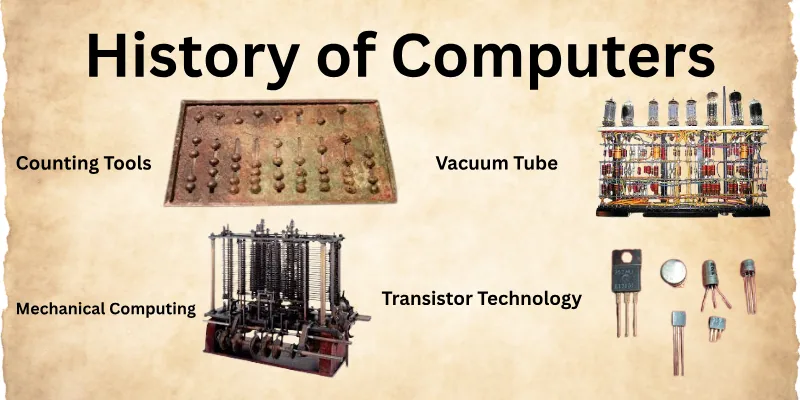
The history of computers shows how machines evolved with human needs over time. Each phase introduced new ideas that improved speed, size, and usability. These changes shaped the computers we use today.
Let’s look at the major stages that marked the evolution of computers.
- Early Counting Tools: Humans used fingers, stones, and sticks to perform basic counting and simple calculations.
- Mechanical Computing Era: Devices like the abacus and mechanical calculators helped people solve math problems faster.
- Programmable Machine Concepts: Early inventors designed machines that could follow instructions to complete tasks.
- 1940s Vacuum Tube Computers: Large electronic systems performed complex calculations but consumed high power and space.
- 1950s Transistor Technology: Smaller components replaced tubes and improved efficiency and reliability.
- 1970s Microprocessors: Single-chip processors made personal computers possible for homes and offices.
- 1980s–2000s Internet Computing: Networked systems connected users globally and expanded digital communication.
- 2010s–Present Smart Computing: Modern systems use intelligent software and advanced hardware to handle complex tasks efficiently
Today’s Computers
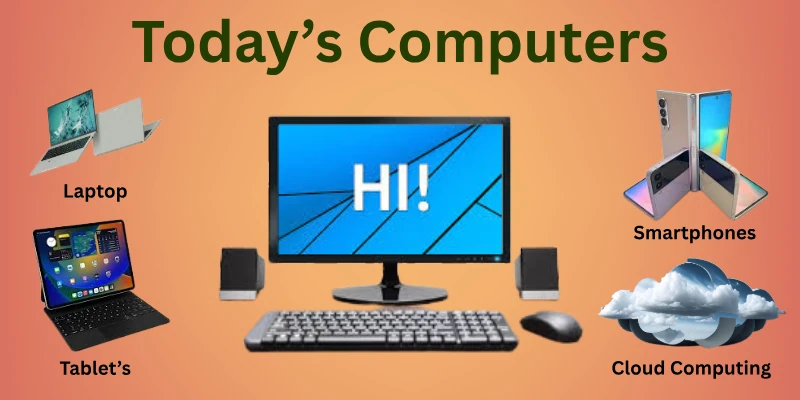
Today’s computers are faster, smaller, and smarter than ever before. They handle complex tasks that used to take hours in seconds. People rely on them for work, learning, entertainment, and communication. Modern computers combine powerful hardware with intelligent software to make life easier every day.
- Laptops: Portable machines that allow users to work and study from anywhere.
- Desktops: Powerful systems for office work, gaming, and professional software.
- Tablets: Touchscreen devices ideal for reading, browsing, and light productivity.
- Smartphones: Mini-computers that fit in your pocket and connect you instantly.
- Servers: High-capacity computers that store data and run websites and applications.
- Wearables: Devices like smartwatches that track health and connect to other computers.
- Cloud Computers: Systems that let users store and process data online without heavy hardware.
- Hybrid Devices: Machines that combine laptops and tablets for flexible use.
Computers in the Future
The future of computers will completely transform the way we live, work, and learn. Machines will become faster, smarter, and more connected to our daily lives. They will help us make decisions, anticipate our needs, and perform tasks we cannot imagine today.
Here is a timeline of key predictions for computers from 2030 to 2060.
- 2030–2035 Self-Learning Systems: Computers will adapt on their own, learn from data continuously, and improve performance without human guidance.
- 2035–2040 Quantum Breakthroughs: Quantum computers will solve problems instantly that today’s devices take years to calculate.
- 2040–2045 Brain-Computer Interfaces: People will interact directly with computers using thoughts, gestures, and neural signals for faster control.
- 2045–2050 Predictive Virtual Assistants: Machines will anticipate user needs, plan schedules, and provide solutions before we ask.
- 2050–2055 Global Real-Time Connectivity: All devices will communicate instantly worldwide, connecting cities, countries, and continents seamlessly.
- 2055–2060 Eco-Friendly and Sustainable Computing: Computers will run on energy-efficient systems and use environmentally friendly materials to reduce the planet’s carbon footprint.
Key Factors Shaping Future Computers
The future of computers will not happen by chance. Several factors will guide how machines evolve and become faster, smarter, and more reliable. Innovations in hardware, software, and connectivity will play a major role. Understanding these key influences helps us prepare for the next generation of computing.
Here are the main factors shaping computers in the future.
- Processing Power Improvements: New processors will handle more calculations at faster speeds while using less energy, allowing computers to perform complex tasks effortlessly.
- Artificial Intelligence Integration: Computers will analyze large amounts of data, learn from patterns, predict user needs, and assist humans in making smarter decisions.
- Quantum Technology: Quantum computers will solve highly complex problems instantly, opening possibilities for science, medicine, and technology that traditional computers cannot reach.
- Energy Efficiency: Future systems will focus on saving energy and minimizing environmental impact, making computers more sustainable and cost-effective.
- Connectivity and Networking: Ultra-fast networks will allow computers and devices to communicate instantly across the globe, enabling seamless collaboration and data sharing.
- Advanced Storage Solutions: Computers will store enormous amounts of information safely and access it almost instantly, supporting faster computing and larger datasets.
- User-Centric Design: Machines will become highly intuitive, easy to use, and adaptable to individual preferences, improving the overall user experience.
- Security Enhancements: Strong security systems will protect data, networks, and personal privacy against evolving cyber threats, keeping users and businesses safe.
How Future Computers Will Transform Industries
The future of computers will reshape industries in ways we are only beginning to imagine. Machines will become smarter, faster, and more capable of handling complex tasks. Businesses will rely on advanced systems to make decisions, optimize operations, and deliver better products and services. Understanding how these changes will affect each sector helps companies prepare for the digital future.
Explore how computers in the future will transform the way industries operate.
- Healthcare: Computers will analyze vast amounts of medical data quickly, assist doctors in diagnosing diseases accurately, and personalize treatments for each patient to improve health outcomes.
- Education: Intelligent systems will deliver customized learning experiences, track student progress efficiently, help teachers design lessons, and support students in achieving their goals.
- Finance: Advanced computing will detect fraudulent activities in real time, manage investments more effectively, predict market trends accurately, and help financial institutions make smarter decisions.
- Manufacturing: Automated systems will optimize production lines, reduce waste, improve product quality, and monitor operations continuously to ensure efficiency and safety.
- Retail: Future computers will analyze customer preferences, manage inventories in real time, personalize shopping experiences, and help businesses respond quickly to changing demands.
- Transportation: Smart traffic management systems and autonomous vehicles will make travel faster, safer, and more efficient, while reducing congestion and improving overall mobility.
- Energy: Computers will monitor energy usage, optimize power grids, support renewable energy sources, and help companies and homes save costs while protecting the environment.
- Entertainment: Media production and gaming will rely on advanced computers to create more immersive experiences, generate realistic graphics, and offer personalized content to users.
- Agriculture: Intelligent systems will analyze soil, monitor crops, predict weather effects, and provide farmers with data-driven advice to increase yields and ensure sustainable farming.
- Security: Future computers will detect cyber threats, protect networks and sensitive information, monitor public spaces, and maintain safety across both public and private sectors.
- Research and Development: Computers will simulate complex experiments, analyze massive datasets, generate insights, and accelerate innovation in science, technology, and industry faster than ever before.
Benefits of Future Computers
Future computers will bring major improvements to how people live, work, and interact with technology. They will perform tasks faster, handle complex problems, and make decisions more intelligently. Businesses and individuals will rely on them to increase productivity and efficiency. These advancements will make life easier, safer, and more connected for everyone.
Here are the main pros we can expect from future computers:
- Increased Speed and Efficiency: Future computers will complete tasks in seconds that currently take hours, allowing people to focus on creative and strategic work instead of repetitive processes.
- Enhanced Accuracy: Advanced systems will minimize errors in calculations, operations, and decision-making, which will improve outcomes in industries like healthcare, finance, and research.
- Better Decision-Making: Intelligent computers will analyze large datasets, provide actionable insights, and help users make informed choices faster than ever before.
- Personalization: Machines will understand individual preferences, adapt their functions, and offer customized experiences for work, learning, and entertainment.
- Improved Communication: Future computers will support seamless collaboration across devices and locations, enabling teams and individuals to connect instantly and share ideas efficiently.
- Greater Accessibility: Advanced computing will make powerful tools and information available to more people, regardless of location or technical skill level.
- Sustainability: Energy-efficient designs and eco-friendly systems will reduce environmental impact, lower costs, and support long-term sustainable operations in all sectors.
- Innovation Acceleration: Computers will speed up research and development by simulating experiments, analyzing results, and generating solutions, enabling faster discoveries and technological breakthroughs.
Risks & Challenges of Future Computers
While future computers will bring amazing benefits, they also come with risks and challenges that we cannot ignore. Advanced systems may create security, privacy, and ethical concerns. Rapid technology changes can make devices and skills outdated quickly. Understanding these challenges helps people and businesses prepare for the future safely.
Here are the main risks and challenges of future computers.
- Cybersecurity Threats: As computers become smarter and more connected, they will face more complex cyberattacks that can steal data or disrupt systems.
- Privacy Concerns: Advanced machines will collect and analyze massive amounts of personal data, raising questions about how information is used and protected.
- Job Displacement: Automation and intelligent systems may replace some jobs, requiring workers to learn new skills and adapt to changing roles.
- System Dependence: Relying heavily on computers could make industries and daily life vulnerable to failures or technical glitches.
- High Costs: Developing, maintaining, and upgrading future computing systems will require significant investments for individuals and businesses.
- Ethical Issues: Smart computers may make decisions that raise ethical questions, especially in areas like healthcare, security, and autonomous systems.
- Technical Complexity: Future machines will be highly advanced, requiring specialized knowledge to operate, maintain, and troubleshoot effectively.
- Environmental Impact: Even though efficiency improves, the production and disposal of advanced computer hardware could affect the environment if not managed responsibly.
How Society Can Prepare for the Future of Computers
The future of computers will bring exciting opportunities, but society must be ready to handle changes responsibly. People, businesses, and governments will need to adapt to smarter machines and faster technology.
Preparing now can help everyone use these advancements safely and effectively. Awareness, education, and strategic planning will make the transition smoother for all.
- Invest in Education and Training: Teach digital skills, coding, and data literacy so people can work confidently with advanced computers.
- Promote Cybersecurity Awareness: Encourage safe online practices and educate users about protecting data from cyber threats.
- Develop Ethical Guidelines: Establish clear rules for AI and smart systems to ensure machines make decisions responsibly.
- Encourage Innovation: Support research and development to create new technologies that improve daily life and industry.
- Adapt Workforce Strategies: Prepare workers for automation by offering retraining and new career opportunities in technology-driven fields.
- Strengthen Infrastructure: Build reliable networks and systems to support fast, secure, and connected computing environments.
- Support Policy and Regulation: Governments should implement policies that ensure safety, privacy, and fairness in computing technologies.
- Foster Public Awareness: Inform communities about technological changes, benefits, and potential risks to help them make informed decisions.
Conclusion
In this guide, we explored the future of the computer in detail, with clear examples and insights across industries, education, healthcare, and daily life. From smart PCs and quantum computing to AI integration and brain-computer links, computers are no longer just tools; they are becoming essential partners in how the world works.
As someone who has closely followed computing trends for years, I believe the next decade will bring faster and more connected systems that reshape work, learning, and everyday life. Individuals and businesses who understand and prepare for these changes now will benefit the most as computers continue to evolve.
Visit the FAQs section below to quickly understand key questions about the future of computers and learn how these changes might affect your work, learning, and daily life.
FAQs: Future of the Computer
Here are some of the most frequently asked questions related to the future of the computers.
The future of the computer will bring faster, smarter, and more connected machines. Computers will perform complex tasks, assist in decision-making, and adapt to user needs. They will transform work, education, healthcare, and daily life in remarkable ways.
Yes, future computers will use advanced processors and quantum technology to process information extremely quickly. They will handle large datasets in seconds. This speed will allow researchers, businesses, and governments to make faster and more accurate decisions. This speed will benefit science, business, healthcare, and everyday life.
Security will be a priority for future computers, but risks will still exist. Users must protect data with strong passwords, updates, and secure networks. Organizations will also need to implement advanced monitoring and protective systems to stay safe. Safe usage practices will help prevent cyberattacks and data breaches.
Yes, future computers will focus on energy efficiency. They will perform complex operations while consuming less power. Advances in design and technology will make these systems more sustainable for everyday use. This will reduce costs and help protect the environment.
No, future computers will enhance human intelligence, not replace it. They will help with calculations, predictions, and decision-making. By working alongside humans, these systems will allow people to focus on creative and strategic tasks. Humans will still provide creativity, judgment, and emotional understanding.
Computers will enable instant, global communication across devices. People will connect through video, virtual meetings, and collaborative platforms. Businesses, schools, and communities will collaborate more efficiently than ever before. Information will travel faster and more securely than ever before.
Yes, future computers will analyze data to address challenges like climate change, healthcare crises, and energy management. They will provide insights and solutions faster than current systems. By combining advanced computing with real-world data, these machines will support smarter planning and innovation. This will help governments and organizations make better decisions.
Over time, future computers will become more accessible and affordable. Advances in technology and production will reduce costs. As a result, schools, businesses, and communities will gain better access to advanced tools. More people will benefit from powerful computers in homes, schools, and workplaces, and this will help bridge the digital gap while supporting learning, work, and innovation everywhere.


- Be Respectful
- Stay Relevant
- Stay Positive
- True Feedback
- Encourage Discussion
- Avoid Spamming
- No Fake News
- Don't Copy-Paste
- No Personal Attacks
- Be Respectful
- Stay Relevant
- Stay Positive
- True Feedback
- Encourage Discussion
- Avoid Spamming
- No Fake News
- Don't Copy-Paste
- No Personal Attacks
