Uses of Computers in Daily Life Boost Productivity and Fun
Published: 2 Feb 2026
Have you ever wondered how life would look without computers? Imagine struggling to shop online, track your health, complete work tasks, or even stay in touch with friends and family. From paying bills to booking appointments, computers handle countless small tasks that make our daily lives smoother.
In this detailed guide, we will explore the many uses of computers in daily life and how they save time, reduce stress, and improve productivity. I have personally seen how students, professionals, and even homemakers rely on computers every single day to stay organized and get things done efficiently.
By understanding these practical uses, you can make the most of technology and simplify your own routine in ways you might not have thought possible.
Importance of Computers in Daily Life
Computers play a vital role in our everyday lives. They help us complete tasks faster, manage information efficiently, and stay connected with others. Students use computers to research, write assignments, and learn new skills. Professionals rely on them to organize work, communicate with teams, and handle important data.
At home, computers make shopping, paying bills, and planning schedules easier. Even hobbies like watching videos, listening to music, or editing photos become simple with computers. By using them effectively, we can save time, reduce stress, and achieve more in both personal and professional life.
All Key Uses of Computers in Daily Life
Computers have become an important part of our everyday lives. They make tasks faster, help people stay organized, and make learning and communication much easier. Understanding their key uses can show how deeply these machines impact the way we live and work.
Here is the list of the main ways computers impact our daily lives.
- At Home
- In Education
- In Offices
- Banking and Finance
- Hospitals and Healthcare
- Transportation
- Communication
- Entertainment
- Science and Research
- Government
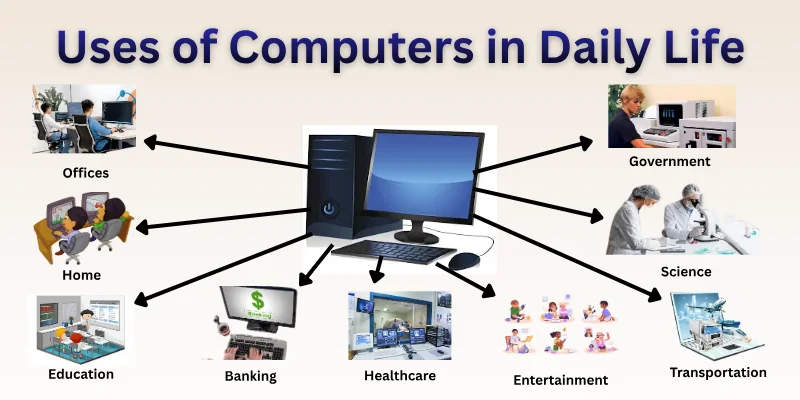
Let’s take a closer look at the key areas where computers play an important role every day.
1. At Home
Life at home has become much easier with computers. They help manage daily tasks quickly and keep information organized. Families can enjoy entertainment, connect with others, and even control smart devices with ease.
Computers also support personal learning and hobbies. They save time on repetitive chores and provide new ways to interact digitally. Overall, they enhance convenience and efficiency in everyday home life.
- Online grocery shopping saves time.
- Home budgeting and expense tracking
- Smart home control for convenience
- Personal hobbies and creative projects
Example:
A family uses a computer to order groceries online, track monthly expenses, and manage smart lights and security cameras from a single device
2. In Education
Computers have transformed education in remarkable ways. Students can access vast resources and learn at their own pace. Teachers can create interactive lessons and evaluate students efficiently. They allow research, project collaboration, and digital exams. Computers also support distance learning and educational games that make learning fun. They play a critical role in modern classrooms and home study alike.
- Virtual classes for remote learning
- Research using online libraries efficiently
- Interactive learning tools for students
- Automated grading and feedback systems
Example:
A student attends an online science class, researches for a project using digital libraries, and submits an assignment that is automatically graded by the computer system.
3. In Education
Modern classrooms rely heavily on technology to make learning engaging. Students benefit from access to digital resources and can study at their own pace. Teachers design interactive lessons that help students understand concepts more clearly.
Group projects and online discussions allow collaboration beyond physical classrooms. Schools and universities also use computers for testing and tracking performance efficiently. Overall, technology creates a more flexible and effective learning environment.
- Gamified exercises increase student engagement.
- Educational apps support skill development.
- Language learning becomes interactive daily.
- Virtual labs simulate real experiments.
Example:
A student uses an online platform to practice math exercises with gamified challenges while collaborating on a group science project through a virtual lab simulation.
4. Banking and Finance
Digital technology has transformed the way people handle money. Online banking allows fast transactions without visiting a branch. Financial institutions use computers to secure accounts and detect fraudulent activity.
Mobile apps help users track expenses and manage budgets easily. Businesses rely on digital systems to process payments quickly and accurately. Overall, technology improves efficiency, safety, and convenience in the financial world.
- Automatic bill payments save time.
- Budgeting apps track daily spending.
- Fraud alerts protect account security.y
- Investment platforms offer instant insights
Example:
A customer pays monthly bills automatically through a banking app while monitoring account balances and receiving fraud alerts in real time.
5. Hospitals and Healthcare
Technology has revolutionized healthcare services worldwide. Medical staff use computers to maintain patient records accurately. Diagnostic machines and imaging tools provide faster and more precise results.
Telemedicine allows patients to consult doctors remotely from home. Hospitals coordinate schedules and treatments efficiently using digital systems. Computers also support research and data analysis for better treatment outcomes.
- EHRs store the complete patient history.
- Online appointments reduce waiting time.
- Remote monitoring improves patient safety.
- Lab results are delivered instantly digitally.
Example:
A patient schedules an online consultation, and the doctor reviews their medical history through the hospital’s electronic records before recommending treatment.
6. Transportation
Modern transportation depends on technology for efficiency and safety. GPS devices guide drivers and reduce travel time. Online booking systems allow travelers to plan journeys from home. Logistic companies rely on computers to schedule deliveries and manage fleets.
Traffic management software helps authorities prevent congestion and accidents. Vehicles are increasingly monitored using predictive maintenance tools.
- Automated toll systems speed up highways.
- Smart traffic lights adjust automatically.
- Fleet management improves delivery efficiency.
- Ride-sharing apps optimize urban travel.
Example:
A delivery company uses smart traffic lights and fleet management software to ensure drivers take the fastest route, while customers track their packages in real time.
7. Communication
Staying connected has become faster and more convenient thanks to digital tools. People exchange messages, make video calls, and share information instantly across the world. Businesses coordinate projects efficiently using online collaboration platforms. Social networks allow friends and communities to interact in real time. Translation software breaks language barriers during international conversations. Every day communication now blends speed, accessibility, and interactivity like never before.
- Voice-to-text reduces manual typing effort.
- Virtual receptionists handle initial calls.
- AI chatbots respond to inquiries.
- Secure messaging apps protect conversations.
Example:
A company uses an AI chatbot to answer customer queries, while employees coordinate tasks using a virtual receptionist and secure messaging apps.
8. Entertainment
Entertainment has changed dramatically with technology. People no longer rely on traditional methods like TV or radio to pass the time. Computers allow access to countless online platforms, offering endless choices. They make it easier to explore hobbies, learn new skills, or enjoy immersive experiences. Content can now be shared instantly across communities. Technology has redefined how people spend their leisure time.
- Cloud gaming allows play anywhere.
- Subscription services provide offline access.
- Motion capture improves film animation.
- Online contests encourage creative participation.
Example:
A teenager participates in an online animation contest using motion capture software while playing cloud-based games and downloading videos for offline viewing.
9. Science and Research
Modern research relies heavily on advanced computing. Scientists analyze complex data sets efficiently. Simulations model experiments safely and quickly. Collaboration tools connect teams worldwide. Computers support accurate reporting and visualization. Technology accelerates discoveries and enables precise results.
- Supercomputers run large simulations.s
- Cloud platforms store global datasets
- Machine learning predicts research trends
- Automated software handles repetitive calculations
Example:
A research team runs a climate simulation on a supercomputer while storing results on the cloud for international collaboration.
10. Government
Governments use digital tools to improve services. Citizens can access records, submit applications, and pay taxes online. Emergency response teams coordinate more effectively. Data analysis supports policy-making and planning. Technology increases transparency and efficiency. Digital systems also streamline administrative operations and reduce paperwork.
- E-governance apps reduce public queues.
- Data dashboards track national projects.
- AI assists in threat detection.
- Online portals simplify form submissions.
Example:
Citizens submit online tax forms while the government monitors progress through a digital dashboard and uses AI to detect anomalies.
Benefits of Computers in Daily Life
Computers have become an important part of our daily routines, helping us accomplish tasks faster and more efficiently. They save time, simplify work, and make information easily accessible. Beyond just work or school, computers improve communication, entertainment, and even personal organization.
Understanding their benefits shows how much they impact both our professional and personal lives.
Save Time: Computers allow us to complete tasks quickly, from writing documents to processing data, reducing effort and speeding up work.
- Improve Productivity: With the right software and tools, computers help us organize projects, track progress, and achieve more in less time.
- Enhance Communication: Email, video calls, and messaging apps make it easier to stay connected with people anywhere in the world.
- Access Information: Computers give instant access to knowledge, research, and resources, making learning and decision-making easier.
- Support Creativity: Tools for designing, editing, and creating content help people bring ideas to life efficiently.
- Manage Daily Life: Computers help organize schedules, reminders, bills, and tasks, keeping life structured and less stressful.
Challenges and Limitations
While computers make life easier, they also come with certain challenges that can affect productivity and well-being. Over-reliance on computers may lead to reduced physical activity and eye strain. Technical issues or a lack of proper knowledge can slow down work and cause frustration. Understanding these limitations helps us use computers more effectively and safely.
- Health Concerns: Prolonged use can cause eye strain, back pain, and poor posture, impacting overall health.
- Dependence on Technology: Relying too much on computers may reduce problem-solving skills and critical thinking.
- Security Risks: Computers are vulnerable to viruses, hacking, and data theft, which can lead to personal or financial loss.
- Technical Issues: Hardware failures, software bugs, or internet problems can disrupt work and cause delays.
- Costly Maintenance: Buying, upgrading, and maintaining computers can be expensive over time, especially for high-end systems.
- Distraction Potential: Easy access to social media, games, and entertainment can reduce focus and productivity.
Future of Computers in Daily Life
Computers continue to evolve and shape the way we live, work, and learn. New technologies will make tasks faster, more efficient, and more accessible to everyone. In the future, computers will play an even bigger role in education, healthcare, communication, and entertainment. Understanding these trends helps us prepare for a more connected and productive life.
- Smarter Automation: Computers will handle repetitive tasks automatically, saving time and reducing human effort in everyday work.
- Enhanced Learning: Advanced educational tools will make learning interactive, personalized, and accessible from anywhere.
- Better Communication: Future systems will improve real-time communication with higher speed, clarity, and security.
- Healthcare Innovation: Computers will support better diagnostics, treatment planning, and remote medical services for patients.
- Efficient Daily Management: Smart applications will help organize schedules, track activities, and manage resources more effectively.
- Creative Opportunities: Future computers will provide advanced tools for designing, producing, and sharing creative work easily.
Conclusion
In this guide, we have covered the uses of Computers in Daily Life. It’s clear that computers touch every part of our routine, but we must handle them responsibly to avoid health or security problems. I suggest managing usage carefully, applying safety tips, and taking regular breaks to maintain balance. This way, we can benefit fully from technology without harm. I appreciate your time and hope this guide added value to your day.
Don’t skip the next part of the FAQs. I hope you will find something more interesting, so don’t miss it. If you miss it, you may lose something new.
FAQS:
People often ask about the uses of computers in daily life. Below is a set of FAQs addressing the most important topics.
Computers help with work, learning, communication, and entertainment every day. People use them to write documents, research information, attend online classes, and connect with friends. They also help with shopping, banking, and personal organization. Overall, computers make daily life easier and faster.
Students use computers to access online lessons, research topics, and complete assignments. They can join virtual classes or watch educational videos to improve understanding. This flexibility allows learning from anywhere, anytime, making education more accessible.
Yes, computers make work faster and more organized. Professionals use software for reports, spreadsheets, and presentations, which saves time. Computers also help with communication, scheduling, and project management to stay on track.
Computers allow users to handle multiple tasks at the same time. You can work on documents, attend meetings, and communicate simultaneously. This ability makes computers ideal for managing busy daily routines. It helps users stay focused and switch between tasks smoothly. As a result, daily work becomes more organized and less stressful.
Computers reduce human errors in calculations and data handling. Software tools provide precise results and automatic checks. This accuracy is especially helpful in finance, education, and office work. It also builds trust in reports and records used for important decisions. Over time, consistent accuracy improves overall efficiency and reliability.
Computers store photos, videos, documents, and records safely. Cloud storage and backups protect data from loss. This ensures important information stays secure and accessible. Users can organize files easily and retrieve them whenever needed. This convenience reduces stress and saves time in daily life.
Parents use computers to track school updates, manage schedules, and access learning resources for children. They also help with online payments and communication. This support simplifies daily family management. Parents can plan activities more efficiently and avoid last-minute confusion. Over time, this digital support helps create a more organized and balanced home routine.
Computers provide real-time access to news and information. Users can read updates from trusted sources instantly. This helps people stay informed and aware of current events. They can also compare different viewpoints to understand topics more clearly. Over time, regular access to reliable news helps people make better decisions in daily life.
Computers encourage learning, creativity, and communication. They help people explore interests and improve skills. This supports continuous personal and professional growth. People can also build confidence by practicing new ideas and sharing their work online. Over time, regular computer use helps develop problem-solving skills that are useful in real life.


- Be Respectful
- Stay Relevant
- Stay Positive
- True Feedback
- Encourage Discussion
- Avoid Spamming
- No Fake News
- Don't Copy-Paste
- No Personal Attacks
- Be Respectful
- Stay Relevant
- Stay Positive
- True Feedback
- Encourage Discussion
- Avoid Spamming
- No Fake News
- Don't Copy-Paste
- No Personal Attacks
