What is an Analog Computer Complete Guide with Real Uses
Published: 19 Feb 2026
Many people feel confused when they hear that not all computers use binary numbers. That confusion often leads them to search for what is an analog computer. The idea sounds complex at first, but it is actually simple.
An analog computer works with continuous physical signals like voltage, speed, or temperature instead of digital numbers. When I explain this clearly to learners, I see their confusion disappear almost immediately.
In this guide, we have covered the core concept in a clear and practical way. You will understand how analog computers work, where they are used, and why they still matter today.
Let’s dive in and understand everything you need to know about analog computers.
Definition of Analog Computer
Analog computers are devices that process continuous physical signals to perform calculations. Unlike digital computers, they do not rely on binary numbers. These machines are designed to model real-world problems using measurements such as voltage, temperature, or speed. They have been widely used in engineering, science, and simulation tasks where precise, real-time computation is required.
- Measure continuous physical quantities.
- Solve complex mathematical problems.
- Display results in real time
- Control machinery in industries
- Model dynamic systems accurately
- Support scientific research tasks
History of the Analog Computer
Analog computers have played a crucial role in scientific and engineering developments long before digital systems became common. Their origins date back to the early 19th century, and they have evolved through multiple generations to handle complex calculations.
These machines were widely used in research, industry, and military applications because of their ability to process continuous data efficiently. Understanding their history gives insight into how modern computing technology developed over time.
Key Timeline Events
- 1822: Charles Babbage designed the Difference Engine to perform automatic calculations using mechanical components.
- 1876: Lord Kelvin introduced the tide-predicting machine to calculate tides for navigation using analog mechanisms.
- 1930s: Early mechanical analog devices were developed for solving differential equations in scientific research.
- 1940s: World War II drove the use of analog computers for military simulations, including artillery and flight trajectory calculations.
- 1950s: Electrical analog computers emerged, using voltage and current to represent continuous variables for engineering tasks.
- 1960s: Analog computers became more precise with the introduction of operational amplifiers, expanding their applications in control systems.
- 1970s–1980s: Hybrid systems combined analog and digital technologies to leverage the strengths of both approaches.
Evolution of the Analog Computer
Analog computers have continuously evolved to meet the growing demands of science, engineering, and technology. Over time, improvements in design, components, and accuracy allowed them to handle more complex calculations.
Innovations in electronics and hybrid systems expanded their use in simulations, control systems, and research. Studying their evolution highlights how analog computing adapted and paved the way for modern computing technologies.
Key Evolution Milestones
- 1920s–1930s: Mechanical analog devices improved precision with gears and levers for scientific calculations.
- 1940s: Wartime developments introduced electrical analog computers, which increased speed and reliability in military simulations.
- 1950s: Operational amplifiers and electronic circuits enhanced accuracy, enabling real-time control in industrial processes.
- 1960s: Analog computers were integrated with early digital components, forming hybrid systems that combined the strengths of both technologies.
- 1970s: Specialized analog simulators modeled dynamic systems like aircraft control and chemical processes more efficiently.
- 1980s: Miniaturization and advances in electronics enabled analog computers to occupy less space while maintaining performance.
- 1990s–2000s: Digital dominance reduced widespread use, but analog systems remained in research and niche applications requiring continuous data processing.
How Analog Computers Work
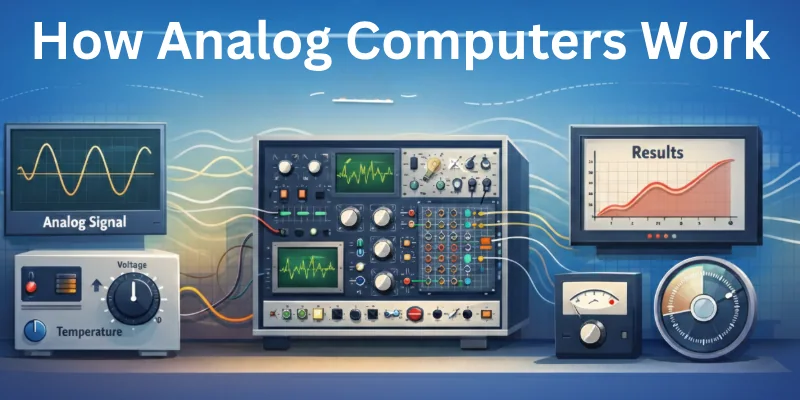
Analog computers perform calculations by processing continuous physical signals instead of digital numbers. They use real-world measurements such as voltage, pressure, or rotation to model problems accurately. These machines rely on components like operational amplifiers, resistors, and capacitors to carry out mathematical operations in real time.
Understanding their working principle helps explain why analog systems are still valuable for certain simulations and industrial applications. Their ability to handle dynamic and continuous data sets them apart from digital computers.
- Process continuous signals: Analog computers convert real-world quantities into electrical signals to perform calculations instantly.
- Use feedback loops: They adjust outputs dynamically by feeding results back into the system to maintain accuracy.
- Perform mathematical operations: Components like amplifiers and integrators calculate sums, differences, and derivatives directly.
- Model physical systems: Engineers simulate processes such as flight paths, chemical reactions, and mechanical motion with precision.
- Display results immediately: Outputs appear on meters, charts, or screens, allowing real-time monitoring and adjustments.
- Control systems efficiently: Analog computers regulate machines, processes, and experimental setups by continuously processing input signals.
Types of Analog Computer
Analog computers come in different types, each designed for specific tasks. Some are mechanical, others are electrical, and some combine both technologies. Knowing the types helps choose the right system for simulation, control, or research. These variations show how versatile analog computers have been over time.
- Mechanical analog computers: Use gears and levers to perform calculations for engineering and navigation tasks.
- Electrical analog computers: Convert measurements into electrical signals to solve problems efficiently.
- Electronic-hybrid computers: Combine analog and digital systems for faster and more accurate simulations.
- Special-purpose analog computers: Designed for tasks like flight simulation or chemical process modeling.
- Continuous-variable analog computers: Handle changing data to model dynamic systems like speed or temperature.
- Digital-analog interfaced systems: Integrate digital control with analog computation for real-time performance.
Features of Analog Computers
Analog computers have several unique features that make them valuable in certain applications. They can handle continuous data, making them ideal for modeling real-world processes.
These machines provide real-time results, which are essential for simulations and control systems. Understanding their features helps identify why they were widely used before digital computers became dominant.
Key Features:
- Continuous data processing: Analog computers can process measurements like voltage, speed, and temperature without converting them to digital form.
- Real-time computation: They deliver immediate results, allowing engineers and scientists to monitor systems as calculations happen.
- Specialized components: Devices such as operational amplifiers, resistors, and integrators perform precise mathematical operations.
- Dynamic system modeling: They can simulate complex physical systems, including mechanical, chemical, and electrical processes.
- Flexible input-output options: Analog computers use dials, meters, and graphical displays to interact with users directly.
- High-speed calculations: Certain computations, especially continuous ones, are performed faster than early digital alternatives.
Characteristics of Analog Computers
These machines work differently from digital systems and have unique qualities that define their operation. They handle continuous data smoothly, making them suitable for real-time modeling and control.
Their design allows them to respond quickly to changing inputs and simulate complex systems accurately. Understanding these characteristics helps explain why analog computers were essential in engineering and scientific applications.
Key Characteristics
- Continuous signal handling: They process real-world measurements like voltage, temperature, or speed without converting them to discrete numbers.
- Real-time responsiveness: Systems react immediately to input changes, enabling accurate monitoring and control.
- High-precision operation: Carefully designed components allow precise calculations for simulations and industrial tasks.
- Dynamic adaptability: Capable of modeling changing environments such as mechanical systems or chemical processes.
- Direct interaction interface: Users can monitor and adjust processes using dials, meters, or graphical displays.
- Specialized design focus: Each system is optimized for specific tasks, enhancing efficiency in its intended application.
Advantages of the Analog Computer
They offer several benefits that make them valuable in specific applications even today. Continuous data processing allows smooth and accurate modeling of real-world systems.
Results appear instantly, making them ideal for simulations and control tasks. These advantages explain why these systems were widely used before digital computers became dominant.
Key Advantages
- Immediate results for continuous monitoring.
- Handle voltage, speed, and temperature directly.
- Perform complex calculations faster than digital.
- Simulate dynamic systems like flight paths or chemical reactions.
- Allow adjustment using dials, meters, or displays.
- Optimized for specific tasks in research and industry.
Disadvantages of the Analog Computer
Despite their benefits, these systems have several limitations that can make them less practical in certain situations. They often require specialized maintenance and careful calibration to remain accurate.
Analog computers are generally less flexible than digital systems when it comes to handling large amounts of data. Understanding these drawbacks helps explain why digital computers eventually became more dominant.
Key Disadvantages
- Needs frequent calibration to stay accurate.
- Limited storage and data handling.
- Prone to errors from wear orthe environment.
- It’s hard to program multiple or complex tasks.
- Bulky size limits portability and setup.
- Hard to integrate with modern digital systems.
Applications of Analog Computers
Analog computers play an important role in areas where systems change continuously and require instant adjustments. Their design allows professionals to observe and manage processes without delays.
Many technical fields depend on them to study movement, energy flow, and physical behavior. Because they respond immediately to input changes, they remain useful in specialized industrial and research settings.
Key Applications:
- Flight simulation training: Engineers use these systems to create realistic cockpit environments where pilots safely practice takeoff, landing, and emergency procedures.
- Electrical system regulation: Power facilities rely on them to maintain stable voltage levels and ensure smooth energy distribution.
- Chemical production analysis: Manufacturing plants use them to observe reaction patterns and control temperature during processing.
- Machine performance evaluation: Designers test motion, load behavior, and efficiency before building full-scale mechanical equipment.
- Climate behavior studies: Researchers model atmospheric shifts and environmental variations for better prediction and analysis.
- Factory process control: Production units depend on them to manage pressure, flow rates, and operational balance.
Why Analog Computers Aren’t Common Today
Analog systems played an important role in early computing, especially in scientific and industrial settings. Over time, technology moved toward more advanced solutions that improved efficiency and reliability.
Modern environments demand systems that handle complex tasks with better control and consistency. Because of these changes, older analog machines gradually lost their position in mainstream use.
- Limited precision reduces reliability in complex calculations.
- Signal noise issues affect output quality during operation.
- Physical components wear out faster over time.
- Design complexity makes upgrades difficult.
- Large hardware size requires more physical space.
- Specialized setup needs make installation challenging.
Final Thought
In this guide, we have covered what is an analog computer. We discussed how it works, where it is used, and why it is not common today. Analog computers have clear strengths, but they also come with limits like lower accuracy and maintenance needs.
I personally recommend understanding both the benefits and risks before using them. You can manage their limitations by using them only for specific tasks where continuous data processing is required and by combining them with digital systems when higher precision is needed.
Thank you very much for taking the time to read this guide. Don’t skip the next part of the FAQs. I hope you will find something more interesting, so don’t miss it. If you miss it, you may lose something new.
FAQS: What is an Analog Computer
Now that you understand what is an analog computer, let’s move to some frequently asked questions to clear any remaining doubts.
They are widely used in engineering, scientific research, and industrial applications. Common uses include flight simulation, control systems, weather modeling, and mechanical system analysis. Analog computers excel in situations that need real-time calculations. They are less common in general-purpose computing today.
For certain continuous calculations, analog computers can deliver results instantly. They do not need to convert data into binary format, which saves time. However, digital computers are faster for large-scale and complex data processing. So speed depends on the type of task being performed.
Yes, they can solve mathematical equations like differential and integral equations. However, their precision is lower than that of digital computers. They are best for tasks where approximate continuous solutions are acceptable. Complex, large-scale data tasks are better handled digitally.
Let’s compare analog and digital computers side by side.
Analog Computer: They process continuous data in real time and work well for simulating physical systems. These systems are specialized and less versatile than modern alternatives.
Digital Computer: Digital computers use binary data for higher accuracy and storage. They handle complex tasks, are flexible, and are widely used today.
Studying them helps understand the principles behind continuous data processing. It provides insight into the history of computing and engineering simulations. Even with digital dominance, analog concepts are useful in control systems and hybrid designs. Learning about them strengthens foundational computer knowledge.
Yes, but it requires understanding circuits and physical signal manipulation. Beginners can start with small simulations using simple components. Learning is easier with hands-on experiments rather than programming. It’s a great way to understand the principles of continuous computation.
Flight simulators and old differential analyzers are classic examples. They process continuous signals to model real-world systems. Industrial control systems in power plants also use analog computation. These examples highlight their real-time processing capabilities.
Industries like aerospace, chemical manufacturing, and power generation use them. Engineers and researchers simulate processes and control systems effectively. They are used where continuous monitoring and real-time analysis are important. This helps improve safety and efficiency in operations.
Key components include operational amplifiers, resistors, capacitors, integrators, and potentiometers. These parts help simulate equations and process continuous data. Displays and meters show real-time results. The combination of these components defines the computer’s capability.
They are still used in flight simulators, industrial process control, and some scientific research. They help monitor mechanical systems, electrical circuits, and environmental models. These computers are chosen when real-time data processing is critical. Many modern analog applications are hybrid with digital systems.


- Be Respectful
- Stay Relevant
- Stay Positive
- True Feedback
- Encourage Discussion
- Avoid Spamming
- No Fake News
- Don't Copy-Paste
- No Personal Attacks
- Be Respectful
- Stay Relevant
- Stay Positive
- True Feedback
- Encourage Discussion
- Avoid Spamming
- No Fake News
- Don't Copy-Paste
- No Personal Attacks
